Learning Areas
Visual Arts | English | HASS
In this unit
This unit introduces students to the impact of colonisation on Adnyamathanha Yarta, focusing on the renaming of First Nations' sacred places. Through discussions and creative activities, students will explore the cultural significance of Adnyamathanha place names, what they teach about the land and its stories, and why recognising and reclaiming these names matters.
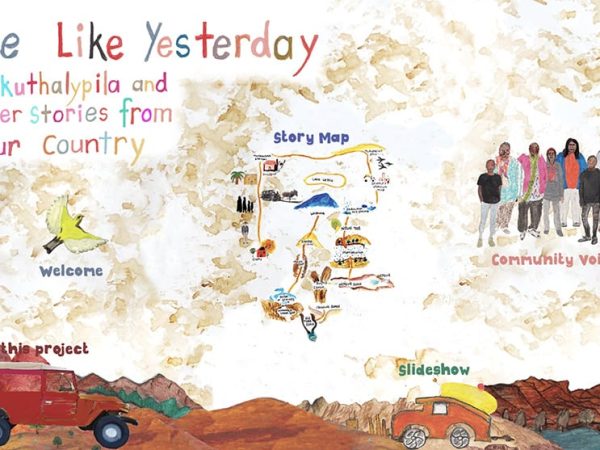
This unit includes:
Learning Areas
- AC9HS5K02
The impact of the development of British colonies in Australia on the lives of First Nations Australians, the colonists and convicts, and on the natural environment - AC9HS5K04
The influence of people, including First Nations Australians and people in other countries, on the characteristics of a place - AC9HS5S01
Develop questions to investigate people, events, developments, places and systems - AC9HS5S05
Develop evidence-based conclusions - AC9HS5S06
Propose actions or responses to issues or challenges and use criteria to assess the possible effects - AC9HS5S07
Present descriptions and explanations, drawing ideas, findings and viewpoints from sources, and using relevant terms and conventions
- AC9HS6S01
Develop questions to investigate people, events, developments, places and systems
- AC9AVA6E01
Explore ways that visual conventions, visual arts processes and materials are combined to communicate ideas, perspectives and/or meaning in visual arts across cultures, times, places and/or other contexts - AC9AVA6E02
Explore ways that First Nations Australians use visual arts to continue and revitalise cultures - AC9AVA6C01
Use visual conventions, visual arts processes and materials to plan and create artworks that communicate ideas, perspectives and/or meaning
- AC9E5LE01
Identify aspects of literary texts that represent details or information about historical, social and cultural contexts in literature by First Nations Australian, and wide-ranging Australian and world authors - AC9E5LE02
Present an opinion on a literary text using specific terms about literary devices, text structures and language features, and reflect on the viewpoints of others - AC9E5LE03
Recognise that the point of view in a literary text influences how readers interpret and respond to events and characters - AC9E5LE04
Examine the effects of imagery, including simile, metaphor and personification, and sound devices in narratives, poetry and songs - AC9E5LE05
Create and edit literary texts, experimenting with figurative language, storylines, characters and settings from texts students have experienced - AC9E5LY06
Plan, create, edit and publish written and multimodal texts whose purposes may be imaginative, informative and persuasive, developing ideas using visual features, text structure appropriate to the topic and purpose, text connectives, expanded noun groups, specialist and technical vocabulary, and punctuation including dialogue punctuation
- AC9E6LE01
Identify responses to characters and events in literary texts, drawn from historical, social or cultural contexts, by First Nations Australian, and wide-ranging Australian and world authors - AC9E6LE05
Create and edit literary texts that adapt plot structure, characters, settings and/or ideas from texts students have experienced, and experiment with literary devices - AC9E6LY04
Select, navigate and read texts for a range of purposes, monitoring meaning and evaluating the use of structural features; for example, table of contents, glossary, chapters, headings and subheadings - AC9E6LY05
Use comprehension strategies such as visualising, predicting, connecting, summarising, monitoring and questioning to build literal and inferred meaning, and to connect and compare content from a variety of sources
Cross Curriculum Priorities
Aboriginal and Torres Strait Islander Histories and Cultures
- A_TSICP1
First Nations communities of Australia maintain a deep connection to, and responsibility for, Country/Place and have holistic values and belief systems that are connected to the land, sea, sky and waterways. - A_TSICP2
The occupation and colonisation of Australia by the British, under the now overturned doctrine of terra nullius, were experienced by First Nations Australians as an invasion that denied their occupation of, and connection to, Country/Place. - A_TSICP3
The First Peoples of Australia are the Traditional Owners of Country/Place, protected in Australian Law by the Native Title Act 1993 which recognises pre-existing sovereignty, continuing systems of law and customs, and connection to Country/Place. This recognised legal right provides for economic sustainability and a voice into the development and management of Country/Place.
- A_TSIC1
First Nations Australian societies are diverse and have distinct cultural expressions such as language, customs and beliefs. As First Nations Peoples of Australia, they have the right to maintain, control, protect and develop their cultural expressions, while also maintaining the right to control, protect and develop culture as First Nations Cultural and Intellectual Property. - A_TSIC2
First Nations Australians’ ways of life reflect unique ways of being, knowing, thinking and doing. - A_TSIC3
The First Peoples of Australia (Aboriginal Peoples) belong to the world’s oldest continuous cultures. First Nations Australians demonstrate resilience in the maintenance, practice and revitalisation of culture despite the many historic and enduring impacts of colonisation, and continue to celebrate and share the past, present and future manifestations of their cultures.
- A_TSIP2
First Nations Australians have sophisticated political, economic and social organisation systems, which include family and kinship structures, laws, traditions, customs, land tenure systems, and protocols for strong governance and authority. - A_TSIP3
The significant and ongoing contributions of First Nations Australians and their histories and cultures are acknowledged locally, nationally and globally.
Related Units
Unit Content